Why Does My Cat Meow at Night?
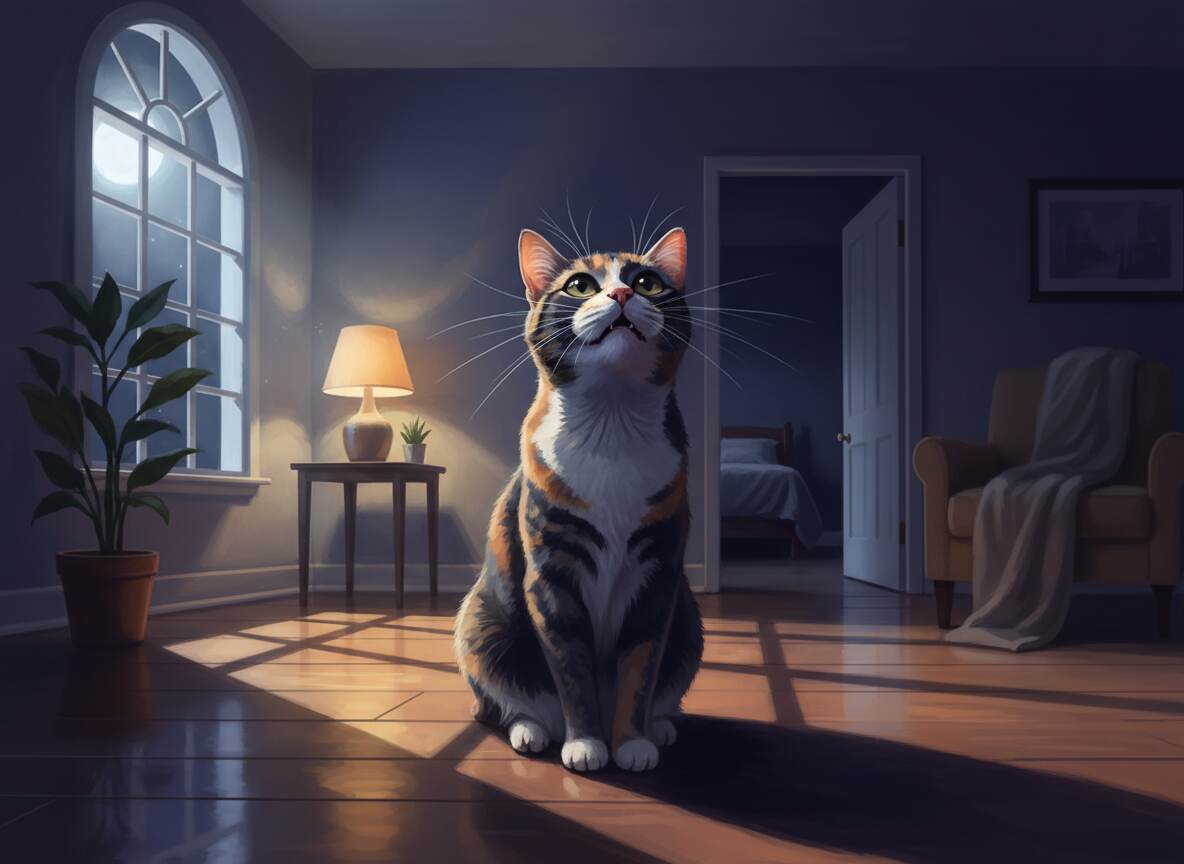
If your cat seems to save their loudest thoughts for the middle of the night, you are definitely not alone. Few things are more confusing, or more exhausting, than being woken up by a cat who is crying in the hallway, meowing outside the bedroom door, pacing around the house, or yowling for no obvious reason. It can sound urgent, lonely, demanding, or even a little unsettling, especially when it happens suddenly.
A lot of cat owners assume nighttime meowing is just one of those annoying cat habits they have to live with, but that is not always true. Cats meow at night for reasons, and those reasons can range from simple routine issues to boredom, hunger, stress, aging, or medical problems. Sometimes the behavior is harmless and fixable. Sometimes it is your cat’s way of telling you something is off.
The most important thing to understand is that nighttime vocalizing is not random. Your cat is not meowing in the dark just to ruin your sleep. Even if the behavior feels frustrating, there is usually a cause underneath it, and figuring out that cause is what helps most.
Some cats are naturally more active at night
One of the most common reasons cats meow at night is simply that their natural rhythm does not always line up neatly with ours. Cats are often most active around dawn and dusk. That means the hours when you are winding down or trying to sleep may be the exact time your cat is feeling alert, playful, hungry, and ready to move around.
This does not mean cats are fully nocturnal in the strict sense, but they often have bursts of energy at times humans would prefer quiet. If your cat spends much of the day sleeping in sunny spots, especially in a calm indoor home, they may be wide awake when the house finally gets dark and still.
For some cats, nighttime meowing is part of that activity cycle. They are awake, they want something, and they are making sure you know it.
Your cat may be bored and under-stimulated during the day
This is a huge one, especially for indoor cats. If your cat does not have enough mental and physical stimulation during the day, nighttime can become their outlet. A cat who has spent hours napping, staring out the window, wandering from room to room, and waiting for something interesting to happen may suddenly decide that 2 a.m. is the perfect time to get active.
Meowing can become part of that release. Your cat may be looking for play, movement, attention, or just some kind of response. If they have learned that nighttime is when they finally get a reaction, even a sleepy one, the habit can become deeply reinforced.
This is why some cats do not just meow at night. They meow, run, scratch at doors, jump on furniture, knock things over, and generally act like they have started a second day while everyone else is trying to sleep.
Hunger is a very common reason
Sometimes the answer is much less mysterious than it seems. Your cat may be hungry. If your cat is used to early meals, gets fed very late and then wakes up hungry again, or has learned that meowing gets breakfast served faster, nighttime vocalizing can quickly become a routine.
Cats are excellent at noticing patterns. If your cat meows at 5 a.m. and you get up to feed them, they learn something important very quickly: meowing works. Over time, they may start earlier and earlier because the behavior has been rewarded.
This does not mean your cat is being manipulative in some grand way. It just means they are smart, observant, and very good at repeating what gets results.
Some cats meow at night because they want attention
Not every nighttime meow is about food. Some cats simply want company. If your cat is especially bonded to you, they may dislike being separated at night, especially if you close the bedroom door or if the house feels too quiet once everyone settles down.
This can be more common in cats who follow their owners closely during the day, cats who were adopted young and are very people-focused, or cats who have recently gone through a change and are feeling less secure. In those cases, nighttime meowing may be less about demand and more about social contact.
A cat who wanders the house calling out may be checking where everyone is, asking for reassurance, or trying to reconnect. Some cats do this briefly and settle. Others keep going because the silence itself seems to bother them.
Stress and anxiety can show up more strongly at night
Night can make certain behaviors feel bigger. During the day, there is movement, noise, sunlight, and distraction. At night, the house changes. It becomes darker, quieter, and less predictable from a cat’s point of view. Small sounds may seem louder. Shadows may feel stranger. Separation may feel more noticeable.
If your cat is stressed, anxious, or unsettled by something in the home, nighttime may be when that discomfort becomes most obvious. A new pet, a move, visitors, construction noise, neighborhood cats outside the windows, changes in your schedule, or tension in the household can all contribute.
Some anxious cats hide. Others become clingy. Others vocalize, especially when the environment feels still enough for them to notice every little thing.
Outdoor cats or neighborhood animals may be triggering the behavior
Sometimes the problem is not inside your cat at all. It is outside the house. If your cat hears, smells, or sees other cats outdoors at night, that can trigger vocalizing, agitation, pacing, and restlessness. This is especially common if neighborhood cats pass by windows, mark territory nearby, or linger in the garden.
Your cat may meow because they feel frustrated, alert, territorial, or overstimulated. They may sit by a window and cry, patrol the room, or wake up suddenly and start calling out. If the behavior seems focused near doors or windows, outside activity is worth considering.
This is one of those causes people often miss because they are half asleep and not looking outside when it happens.
Unspayed or unneutered cats may vocalize more at night
If a cat is not spayed or neutered, hormones can play a major role in nighttime meowing. Cats in heat can become much more vocal, restless, and intense, especially at night. The sounds can be loud, drawn-out, and very different from ordinary meowing. Male cats may also vocalize more if they detect a female nearby.
This kind of vocalizing usually has a more urgent, repetitive quality to it and may come with pacing, rubbing, escape attempts, or unusual restlessness. If your cat is not yet fixed, this should be high on the list of possible explanations.
Senior cats may meow at night because of aging changes
If an older cat suddenly starts meowing at night, it is important not to dismiss it as just a quirky old age behavior. Senior cats can become more vocal at night for several reasons, including confusion, sensory decline, pain, high blood pressure, hyperthyroidism, kidney disease, or cognitive dysfunction.
Some older cats seem disoriented after dark. They may wake up and not feel fully sure where they are. They may call out more because their hearing or vision has changed, because they feel vulnerable, or because their sleep-wake cycle is shifting. A cat who used to sleep peacefully through the night but now wanders and cries deserves a closer look.
This is one of the biggest reasons sudden nighttime meowing should not be ignored, especially in older cats.
Pain or illness can absolutely cause nighttime vocalizing
Cats do not always show discomfort in obvious ways. Some become withdrawn and quiet. Others become restless and vocal, especially when the house is calm and there is less distraction. Pain from arthritis, digestive upset, urinary issues, dental disease, thyroid problems, cognitive changes, or other medical conditions can all affect nighttime behavior.
A cat who meows at night and also seems restless, hides more, eats differently, drinks more, loses weight, vomits, has litter box changes, or acts unlike themselves should be evaluated by a vet. Even if the meowing seems behavioral at first, medical causes need to be ruled out when the pattern is new, intense, or paired with other changes.
This is especially true if the sound is more like yowling than ordinary meowing. A distressed, repetitive, or unusually loud nighttime cry can be a red flag.
Your cat may have accidentally trained you
This sounds funny, but it is often true. If your cat meows at night and you respond by feeding them, talking to them, opening a door, picking them up, or even telling them to stop, your cat may learn that nighttime meowing gets results. From their point of view, any response can be rewarding.
Cats do not always care whether the attention is positive in the way humans think about it. If they wanted engagement and they got engagement, the behavior may continue. Over time, what started as occasional meowing can turn into a strong routine because it has worked often enough to stick.
That does not mean the original reason was fake. It just means the behavior may now be reinforced on top of whatever started it.
Why some cats meow outside the bedroom door
This is one of the most common versions of the problem. Your cat may be perfectly quiet until the bedroom door closes, then suddenly begin crying, scratching, or pacing outside. In many cases, this is about access and attachment. Cats are territorial and curious, and a closed door can feel both frustrating and suspicious. If the room contains their favorite person, their preferred sleeping spot, or simply a space they consider part of their normal territory, being shut out can trigger vocalizing.
For some cats, it is about wanting to sleep near you. For others, it is the closed door itself that becomes the issue. Cats often want access even when they do not fully use it. The idea of a barrier can be enough to set them off.
When nighttime meowing is probably harmless
Nighttime meowing is often more of a routine or enrichment issue when your cat otherwise seems healthy, relaxed, and normal. If they eat well, use the litter box normally, move comfortably, behave like themselves during the day, and the meowing tends to happen around predictable times, the cause may be behavioral rather than medical.
A younger or middle-aged cat who meows at dawn, wants breakfast, gets the zoomies at night, or complains when shut out of a room may not be in distress. They may simply need a better routine, more stimulation, or clearer boundaries.
That said, even harmless nighttime meowing can become exhausting for owners, so it is still worth addressing.
When you should worry more
You should take nighttime meowing more seriously if it is sudden, intense, or paired with other changes. If your cat seems confused, disoriented, unusually needy, restless, aggressive, withdrawn, or physically unwell, that points away from a simple habit and more toward stress or illness.
Red flags include:
- increased thirst
- weight loss
- appetite changes
- vomiting
- litter box problems
- pacing
- staring into space
- seeming unable to settle
- hiding during the day
- unusual yowling rather than normal meowing
- a major behavior change in an older cat
If something feels different beyond the noise itself, trust that feeling. Cats are subtle, and behavior changes are often one of the first clues that something is wrong.
How to help a cat that meows at night
The best solution depends on the cause, but in many cases, improving your cat’s daytime routine helps a lot. More interactive play in the evening can make a real difference, especially if it gives your cat a chance to chase, pounce, and burn off energy before bedtime. Food puzzles, climbing spaces, window perches, and toy rotation can also help reduce boredom.
For cats who wake up hungry, adjusting meal timing may help. A small meal later in the evening can sometimes reduce early morning wakeups. Automatic feeders can also be useful because they break the link between you and the overnight or dawn meal. If food arrives from a machine instead of from your sleepy body getting out of bed, the meowing may gradually lose some of its power.
If your cat seems anxious, focus on making nights feel predictable. Keep the evening routine calm. Offer cozy sleeping spots. Reduce outside visual triggers if neighborhood cats are part of the problem. In some homes, closing blinds or blocking access to certain windows at night helps more than people expect.
If the issue involves bedroom-door crying, consistency matters. If you sometimes let your cat in, sometimes feed them, and sometimes respond with attention, the behavior can become even more persistent because the reward is unpredictable. Cats tend to keep trying very hard when a response works only occasionally.
What not to do
Do not punish your cat for meowing at night. Shouting, spraying water, or scaring them may stop the sound for a moment, but it does not solve the cause. In anxious cats, it can make the problem worse by adding more stress to the night.
It is also not a good idea to assume every nighttime meow is just attention-seeking. That mindset can make people miss real medical or emotional problems. If the behavior is new, stronger than usual, or paired with other changes, it deserves a closer look.
A good first question to ask yourself
One of the most useful things you can ask is this: Has anything changed? A new routine, a move, a different feeding time, a new pet, aging, health changes, outdoor cat activity, or even your own schedule can all shift your cat’s nighttime behavior. The meowing may feel like it came out of nowhere, but often there is a trigger once you start looking closely.
Final thoughts
If your cat meows at night, there is usually a reason behind it. Hunger, boredom, routine, attention-seeking, stress, outside triggers, aging, and medical issues can all play a role. Sometimes the answer is simple. Sometimes it takes a bit of detective work. Either way, the behavior means something.
The goal is not just to make the house quieter. It is to understand what your cat is trying to communicate. Once you look at the full picture, including your cat’s age, health, routine, and environment, the nighttime noise usually starts to make a lot more sense.
And if your cat’s meowing has changed suddenly, sounds distressed, or comes with any other unusual symptoms, it is always worth checking in with your vet. A noisy night can be frustrating, but sometimes it is also an important clue.